The GEO Grift: A Love Letter to Everyone Selling You SEO’s Funeral

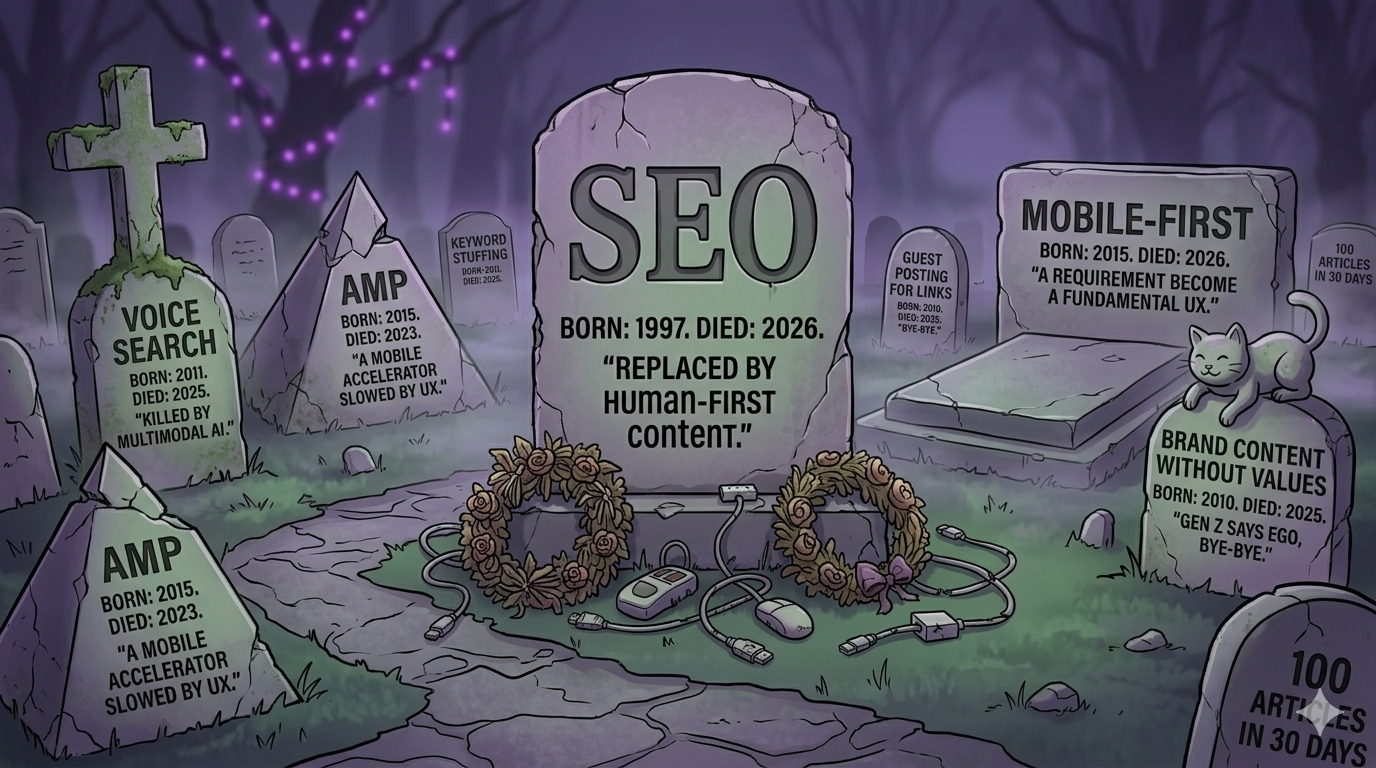

Let me save you 47 LinkedIn carousels and three "AI Search Summit" tickets:
SEO is not dead. GEO is not new. AEO is not a paradigm shift. And the loudest voices telling you otherwise are either selling you something or were never very good at SEO in the first place.
I'll wait while you screenshot.
The "SEO is dead" people have been wrong for 15 years and still won't stop
Every two to three years, a new acronym shows up to murder SEO. Voice search was going to kill it. Featured snippets were going to kill it. Mobile-first was going to kill it. Now it's AI Overviews and ChatGPT.
SEO didn't die. It evolved. Which is what it has always done. Which is what every actually-good SEO has been quietly doing while the LinkedIn thought leaders write obituaries for clicks.
The grift works like this: declare the old discipline dead, rename a subset of it, sell yourself as the expert in the new thing. Repeat every 18 months. Cash checks.
Let's talk about "prompt optimization"
If you've been doing SEO for more than ten minutes, you stopped tracking individual keywords a decade ago. You've been optimizing for topics, intent, and entity relationships since at least 2015. Maybe earlier if you were paying attention.
So forgive me if I don't need a $2,000 course to learn that "prompts" are just longer queries and "query fan-outs" are just topical clusters with a fresh coat of paint.
The "GEO content strategy" being sold right now is, I am not making this up, write comprehensive, well-structured content that answers user questions and demonstrates expertise.
That's SEO. That's been SEO. That was SEO when your "GEO consultant" was still in middle school.
Here's what's actually different (and it's not the content)
Optimizing for AI search isn't a new discipline. It's foundational SEO with a PR layer bolted on top.
The thing that's actually changed is citation surface area. LLMs cite sources. Those sources are weighted by authority, mention volume, and contextual relevance across the open web. Which means the real GEO play is the same play digital PR people have been running forever: get mentioned in the right places, by the right outlets, in the right context.
That's it. That's the whole shift.
You still need crawlable, well-structured content. You still need E-E-A-T signals. You still need internal linking that doesn't read like it was generated by a 2008 plugin. You still need clean technical fundamentals. None of that goes away. It got more important, not less.
What's added is: you now need to think like a PR strategist on top of being a technical SEO. Which, again, the good ones have been doing this whole time. We just called it "digital PR" or "brand-led search" instead of slapping a new three-letter acronym on it.
The real reason this grift works
It works because most marketing leaders don't actually understand SEO. They never did. They hired SEOs because they were told to, treated them like a cost center, and never looked under the hood.
So when a confident person on LinkedIn announces that everything they didn't understand is now obsolete and there's a shiny new thing they should buy, they buy it. Because they don't know what they're buying or what they were buying before.
The grifters know this. That's the whole business model.
Who I'm actually mad at
Not the marketers getting sold to. They're doing their best.
Not even most of the "AI Search Experts," honestly. Some of them are practitioners who genuinely care about the work and just got swept up in the language.
I'm mad at the people who know better and are doing it anyway. The agency founders rebranding their sites with GEO buzzwords while their teams quietly do the same SEO they did last quarter. The "thought leaders" repackaging Moz blog posts from 2014 as breakthrough AI insights. The tool vendors charging Series-B prices for what is functionally a rank tracker with sentiment analysis.
You know who you are. Stop it.
What I tell my clients (and what you should tell yours)
GEO is SEO. AEO is SEO. The fundamentals didn't change. What changed is which signals matter more, where citations happen, and how much PR work you need to do to land in the model's training and retrieval set.
If your "SEO" wasn't already covering that, your SEO was bad. The answer isn't to rename it. The answer is to do it right.
Welcome to the future. Same as the past, but with more acronyms and worse vibes.