AI Visibility Tools, Honestly Reviewed

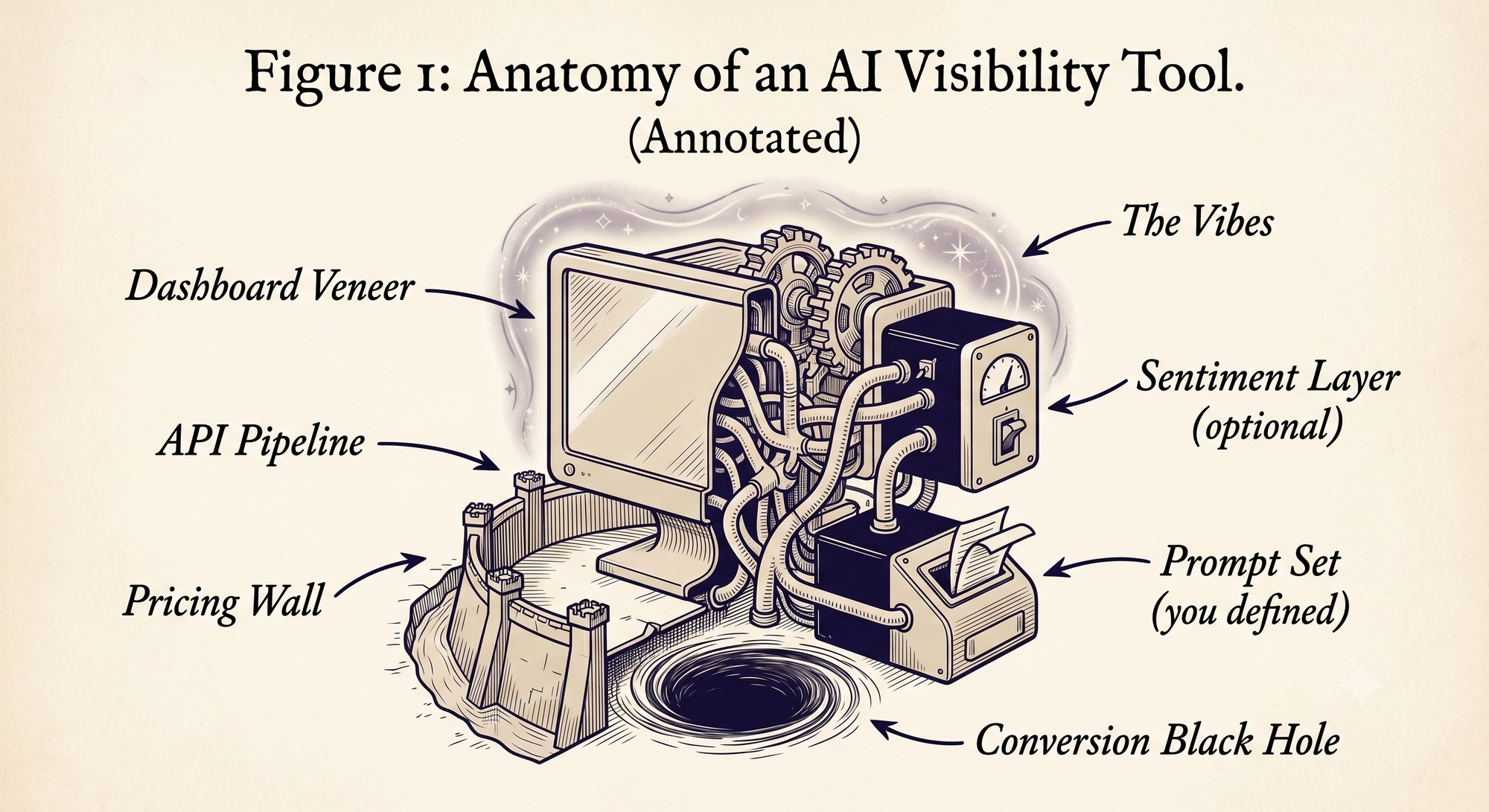
Every other LinkedIn post in my feed right now is someone announcing they've "added AI visibility tracking to our stack." Cool. Most of them haven't said which tool. Many of them couldn't tell you, because the procurement decision was made above their head by someone who saw a demo and signed a contract.
I've been in the space long enough to have used and evaluated most of the major players. Here's the honest review nobody else is writing because everyone's either affiliated with a tool, getting comped on one, or hoping to consult for one.
Spoiler: most of them are a dashboard sitting on top of an API call. A few of them are genuinely useful. None of them solve the actual problem.
What I've used and evaluated
Profound is the one I actually use. AirOps, Gumshoe, Scrunch, and Athena are ones I've evaluated, demoed, or run trials on. I'm not going to pretend to have hands-on with every tool in the space because there are dozens at this point and the new entrants pop up faster than anyone can keep up with. If your favorite isn't here, that's because I haven't put my hands on it personally, and I'm not going to fake it.
Here's what each one actually does and what they don't.
Profound
The clear leader. Worth the investment if you can defend the spend.
What works: real prompt volume estimation (the only tool I've used that gives you actual estimated prompt volumes across LLMs, not vibes), multi-engine tracking across ChatGPT, Gemini, AI Overviews, Copilot, and Perplexity, and a clean citation graph that lets you see who's getting cited around you. The recent push into Agents added content workflows, CMS publishing integrations, and pre-built templates that turn the data into action instead of just dashboards.
What's frustrating: pricing is enterprise-positioned. Starter is around $99/month with limited prompts and engine coverage. Growth is $332.50/month with broader access. Real coverage starts at custom pricing, which means a sales call, which means a procurement cycle, which means it's not actually accessible to mid-market teams or agencies trying to use it for clients. If you're an enterprise marketer with budget and a defensible AI visibility line item, Profound is the move. If you're scrappy, the math gets ugly fast.
The other honest critique: Profound tells you where you appear in AI answers. It does not tell you what that's worth. Visibility is not revenue. Citations are not conversions. Nobody in this category solves that yet, but Profound is the most honest about the gap.
Verdict: buy it if you can afford it. Skip it if your AI visibility line item can't survive a board question about ROI.
AirOps
Positioned as a content engineering platform with AI visibility layered on top. The pitch is "monitoring plus execution," which is genuinely the right framing. The problem is the execution side is more developed than the visibility side.
What works: the agent/workflow builder is solid if you're already running content production at scale and want AI visibility insights piped into your content refresh process. CMS integrations are real. The "Actions" framework is the closest anyone's come to closing the loop between "we noticed a gap" and "we shipped a fix."
What's frustrating: pricing starts at $200/month for Solo (ChatGPT-only tracking). To get real multi-engine coverage you're looking at $1,000+ tiers. For the visibility-tracking piece alone, you're paying twice what Scrunch costs and getting similar engine coverage. The bet is on the content production capabilities, which means if you're not going to use those, you're overpaying.
Verdict: a fit for mid-to-enterprise content teams that want one tool for both insight and execution. Overkill if you just need visibility tracking.
Scrunch
Built around competitive AI visibility. "Where am I vs my competitors in AI answers" is the central question Scrunch is trying to answer.
What works: clean competitor benchmarking, sentiment overlay on top of standard mention and citation tracking, and a presence/influence score that's useful for category-level reporting. Cheaper than Profound or AirOps.
What's frustrating: it's mostly diagnostics. The execution layer is light. You get a clear picture of where you're losing ground, and then you go back to your content team and tell them to fix it manually. Reporting is solid. Doing is not part of the product.
Verdict: a fit for brand teams who care about AI sentiment and competitive position. Not a fit for teams who want one tool that closes the loop.
Athena (AthenaHQ)
Built on prompt-level visibility. The thesis is that the prompt is the right unit of measurement, not the page, not the keyword, not the model.
What works: prompt-level dashboards that show you exactly which prompts you win, lose, and contest. A recommendation layer that turns dashboards into prioritized action lists. Audit-grade depth if you have an analyst who can interpret it.
What's frustrating: credit-based pricing model that makes ongoing tracking unpredictable. Around $295/month minimum. Limited execution layer. If you don't already have an established GEO program with a dedicated analyst, Athena's depth is wasted.
Verdict: a fit for mature programs with internal analysts. Wrong tool for teams just starting their AI visibility journey.
Gumshoe
Pay-as-you-go visibility tracking. Around $0.10 per conversation analyzed. Persona-based AI visibility framing.
What works: low barrier to entry. If you only need periodic audits or you're a consultant running visibility checks for clients, the usage-based pricing is genuinely useful. You don't have to commit to a $300/month subscription to run a few diagnostics.
What's frustrating: limited multi-engine coverage. Limited execution layer. Limited everything except the price model. It's a tool for spot-checks, not ongoing programs.
Verdict: a fit for consultants, agencies running one-off audits, or teams trying to baseline before committing to a real tool.
The category-level problem
Now the part nobody in this space wants to talk about.
You're only monitoring what you're tracking. This is the foundational SEO problem reborn for the AI search era. Every tool in this category requires you to define a prompt set. The tool then tells you how you perform against that prompt set. The blind spot is everything outside the set. The prompts you didn't think to track. The phrasings that emerged this month. The categories you don't compete in yet but should.
This is the same problem we've had in keyword-based SEO for two decades, dressed up in new clothes. If you only track 100 prompts, you only know 100 prompts of reality. The other infinite prompts users are asking? Nobody's measuring those for you. Profound's prompt volume estimation gets closest to solving this, but even that's bounded by what the tool's API call surfaces.
The data loss from LLM to conversion is brutal. Here's the actual unsolved problem. You can know you're cited in AI answers. You can even know which prompts drove the citation. What you cannot know, with any reliability:
- Whether the citation drove a visit
- Whether the visit drove a conversion
- Whether the user converted later through another channel and the AI citation was the assist
- Whether the user converted at a competitor instead because the citation framing wasn't strong enough
This is the conversion attribution problem on hard mode. Traditional referral data from AI engines is sparse, inconsistent, and often anonymized at the source. The user clicks through (sometimes) and lands on your site (sometimes) and your analytics shows "direct" or "referral: chatgpt.com" if you're lucky. Most don't click through at all. The answer was delivered. The transaction never closed.
Every tool in this category is selling you a top-of-funnel metric. None of them connect to the bottom of the funnel. Nobody has solved this yet, and pretending otherwise is the actual grift.
What we should be measuring
Since we're being honest. The four metrics that actually matter for AI visibility, in my opinion:
1. Visibility. Are you appearing in AI answers for relevant prompts? This is the table-stakes question and every tool measures it. Just understand the caveat: visibility is bounded by your prompt set.
2. Sentiment. How is AI characterizing your brand when it does mention you? Are you the recommended option, the also-ran, the criticized option, or the neutral mention? Scrunch and Athena handle this best.
3. Citation score. Not just "are you cited," but "how often relative to competitors," "what authority weight does the citing context carry," and "how does that citation share change over time." Profound's citation graph is closest to a real version of this.
4. Conversion. The one nobody can fully measure yet. Direct traffic from AI engines (where attributable), assisted conversions (where attribution lets you connect them), and downstream revenue impact. Build whatever proxy you can. Be honest about the gap. Don't let your CMO believe the visibility dashboard is a revenue dashboard.
If your AI visibility tool only measures #1, you're paying enterprise prices for a top-of-funnel report. If it measures #1 through #3, you have a real diagnostic. Nobody measures #4 well yet. Anyone telling you they do is selling something.
What to actually buy
If you're an enterprise team with budget and a defensible AI visibility line item: Profound. Get the custom plan. Use the prompt volume data. Use the agents. Connect to your CMS. Build the loop.
If you're mid-market and need both monitoring and execution in one tool: AirOps. Be honest about whether you'll actually use the content workflow side. If you won't, skip it and buy something cheaper.
If you need competitive intelligence and sentiment overlay: Scrunch. Lighter spend than Profound, focused on the brand perception layer.
If you have a mature GEO program with a dedicated analyst: Athena. Prompt-level depth pays off if you can act on it.
If you need spot-check audits or you're a consultant: Gumshoe. Pay-as-you-go works for episodic needs.
If you have no budget and you want to baseline: HubSpot's free AI Search Grader is a starting point. Don't pretend it's a strategy.
If your AI visibility tool is going to be the only line item in your GEO budget and you're not also investing in PR, technical SEO, content quality, structured data, and brand authority: save your money. No tool will surface citations you haven't earned. The work has to happen. The tool just tells you whether the work worked.
The summary
The good tools are tools. The bad ones are dashboards pretending to be strategies. None of them solve the LLM-to-conversion gap. All of them are useful diagnostics if you know what you're looking at and worse than useless if you don't.
Buy with eyes open. Demand honesty about what the tool measures and what it doesn't. Ask hard questions about conversion attribution. Don't sign the contract until someone on your team can articulate exactly what the dashboard will and won't tell you.
The AI visibility category is going through what SEO went through in 2008. A lot of new tools. A lot of overlap. A lot of "platforms" that are really just APIs with a skin. The shakeout is coming. The ones that survive will be the ones that solve real problems instead of selling the appearance of solving them.
Pick accordingly.